
"early coffee planting"
7000 article(s) found

Introduction to the planting History of famous Coffee beans in Yemen the difference between Mayili coffee beans and mocha coffee beans in Yemen
Professional coffee knowledge exchange more coffee bean information please follow the coffee workshop (Wechat official account cafe_style) for lovers who dabble in coffee slightly, when it comes to Yemeni coffee, it is easy to associate it with Mocha. Yemen has a long history of growing coffee. By the early 17th century, Yemeni coffee beans began to be exported to Europe from the southwestern port of Mocha, and Europeans began to use them.

Ethiopia Yega Snow Coffee Holsey all Red Honey Coffee Flavor Taste how to deal with Yega
Professional coffee knowledge exchange more coffee bean information please follow the coffee workshop (Wechat official account cafe_style) Ethiopian coffee Yega Xuefei Garse processing plant (Ethiopia Yirgacheffe Garse Sation G1 N) flavor description: rare pineapple flavor, very much like pineapple ice in a small shop in front of a primary school. Due to too much Rain Water in the early stage, it led to a new birth.

Multinational food giant Yunnan grabs "beans"
Su Bo, president of Nestl é Greater China, revealed on April 2 that Nestl é will invest 100 million in warehousing and testing facilities in Pu'er, Yunnan Province, which will become its largest coffee cultivation training base. At the same time, the first coffee grower support center in Asia by the international coffee chain Starbucks opened in Pu'er, Yunnan Province, as early as four months ago. In addition, the early stage has entered

A brief introduction to Coffee planting History and planting techniques
According to historical records, coffee trees were first planted in Taiwan in 1884, and coffee cultivation in mainland China began in Yunnan. In 1902, a French missionary named Tian introduced seeds from Yinggong County in Binchuan County, Yunnan Province. it was successfully planted in a place called Zhu Kula, which is located on the bank of the Yushan River, a tributary of the Jinsha River. The commercial cultivation of coffee in Yunnan began in 1985, but its development is slow.

The planting technology of coffee the planting environment introduces which country is the most suitable for growing coffee
Field management of loosening soil and weeding: when the seedling height is 3cm to 6cm, the weak or overdense seedlings are pulled out; when the seedling height is 10cm and 13cm, the plant distance is about 30cm. Soil loosening and weeding were carried out at the same time between seedlings and fixed seedlings to keep the soil loose. Coffee beans are more drought-tolerant, and the soil can grow normally when the soil moisture is maintained. During the drought, the coffee beans should be properly watered, but there should be less squatting seedlings during the seedling fixing period.

What are the characteristics of coffee beans in Las Haas Manor in Costa Rica? how much is the coffee in Las Haas Manor?
Professional barista exchanges please pay attention to the coffee workshop (Wechat official account cafe_style) Las Haas Manor, Costa Rica, what are the characteristics of coffee beans? Las Haas Manor Coffee how much is Ruslajas Manor Black Honey treatment Finca Las Lajas Black Honey ■ country: Costa Rica ■ production area: central Valley ■ altitude: 1300-1500 m ■ treatment

Introduction of planting methods of coffee trees introduction of planting conditions of various coffee trees which country is the most suitable for planting
Field management of loosening soil and weeding: when the seedling height is 3cm to 6cm, the weak or overdense seedlings are pulled out; when the seedling height is 10cm and 13cm, the plant distance is about 30cm. Soil loosening and weeding were carried out at the same time between seedlings and fixed seedlings to keep the soil loose. Coffee beans are more drought-tolerant, and the soil can grow normally when the soil moisture is maintained. During the drought, the coffee beans should be properly watered, but there should be less squatting seedlings during the seedling fixing period.

Costa Rica | Central Valley producing area | Ras Lajas Manor Black Honey | Black Soul treatment
Professional coffee knowledge exchange more coffee bean information please follow the coffee workshop (Wechat official account cafe_style) front street coffee individual coffee recommendation | Costa Rica Shumawa black honey | Costa Rica Angel Manor Sun name: Costa Rica La Lajas Manor Black Honey (fruit wine flavor) (Costa Rica Finca Las Lajas Black Honey)

Kenya Coffee Origin Ethiopia
Kenya is bordered to the north by Ethiopia, the origin of Arabica coffee trees, but it was not until the beginning of the 20th century that coffee cultivation began. In the 19th century, missionaries introduced Arabica trees from the leaves, but did not plant them in large quantities. It was not until 1893 that coffee was cultivated on a large scale because of the introduction of Brazil's ancient bourbon seeds. That is to say, Kenyan coffee is of Brazilian origin, because of water.

A brief introduction to the description of the flavor, taste and aroma characteristics of Santo Domingo boutique coffee beans
The temperate climate in Dominica is conducive to coffee cultivation, and the best places to grow coffee are the Barahona region in the southwest and the Cibao Valley north of Santiago, Dominica's second largest city. The northern region, represented by Hibao, and the southern region, including Okayabani Santo Domingo, produce good coffee. Among them, Santo

A brief introduction to the planting Market Price of Fine Coffee Bean varieties in Santa Cruz Manor
As coffee is consumed by people all over the world, the world coffee industry is also moving towards mass production, while St. Cristobal, a small and unreliable coffee industry, is in trouble and is likely to be forced to give up without profit. It wasn't until the early 1990s that the Gonzalez family bought Hasunda Coffee Park. Humboldt current (HumboldtCurr

Zambian coffee producing areas produce fresh fruit and acidity
Professional coffee knowledge exchange More coffee bean information Please pay attention to Coffee Workshop (Weixin Official Accounts cafe_style) Front Street-Zambia Coffee Introduction Coffee was brought into Zambia by missionaries from Tanzania and Kenya in the 1950s. Coffee production, however, had to wait until the late s and early s, when funding from the world bank

Dominica Santo Domingo Coffee Flavor description abrasion Variety characteristics of Fine Coffee
Located in the Jarabacoa region near Siwao, it has the largest farm in Dominica, Ramirez Manor (RamirezEstates), which mainly grows Kaddura varieties, and most of the coffee produced is sold to Europe, the United States and other western countries and regions. Ramirez Manor itself produces coffee in an environmentally friendly way. Coffee from Dominica is made with A.

Introduction to the processing method of Yunnan small Coffee Huaguoshan Coffee Bean
The western and southern parts of Yunnan Province are located between 15 N and the Tropic of Cancer, most of which are 1000-2000 meters above sea level. The topography is dominated by mountains and slopes, with large ups and downs, fertile soil, sufficient sunshine, rich rainfall and large temperature difference between day and night. These unique natural conditions form the special taste of Yunnan small-grain coffee, which is strong but not bitter, fragrant but not strong, slightly fruity. As early as fifty years

A brief introduction to the treatment method of grinding degree and baking degree of full-grained Santo Domingo fine coffee beans
The temperate climate in Dominica is conducive to coffee cultivation, and the best places to grow coffee are the Barahona region in the southwest and the Cibao Valley north of Santiago, Dominica's second largest city. The northern region, represented by Hibao, and the southern region, including Okayabani Santo Domingo, produce good coffee. Among them, Santo

A brief introduction to the history and culture of the origin and development of Panamanian boutique coffee beans Cupid coffee
Farmers harvest complete coffee berries by hand and send them to nearby CafedeEletaS.A. For post-processing, the treatment plant is about 4 kilometers away from the farm, and a modern laboratory is set up for cup testing tube and manual screening.

The planting technology of coffee tree introduces the environment in which coffee tree is suitable to grow.
Field management of loosening soil and weeding: when the seedling height is 3cm to 6cm, the weak or overdense seedlings are pulled out; when the seedling height is 10cm and 13cm, the plant distance is about 30cm. Soil loosening and weeding were carried out at the same time between seedlings and fixed seedlings to keep the soil loose. Coffee beans are more drought-tolerant, and the soil can grow normally when the soil moisture is maintained. During the drought, the coffee beans should be properly watered, but there should be less squatting seedlings during the seedling fixing period.

How much is Tibica coffee? how much is a cup of Yunnan Tibica coffee? how much is a kilogram of Tibika coffee?
Professional coffee knowledge exchange more coffee bean information Please follow the coffee workshop (Wechat official account cafe_style) there are countless branches of coffee varieties, such as the Arabica Tibica among the three native species. The three earliest subspecies in the Arabica species (Coffea arabica) series are: blue Mountain subspecies (varietal Blue Mountain), Tibika subspecies (

Characteristics of Kenyan coffee beans Kenyan coffee producing areas
It entered Kenya in the 19th century, when Ethiopian coffee drinks were imported into Kenya through southern Yemen. But it was not until the early 20th century that the bourbon was introduced by the St. Austen Mission (St.AustinMission). Kenyan coffee is mostly grown at an altitude of 1500m, 2100m, and is harvested twice a year. To ensure that only ripe berries are picked, people must be in the forest
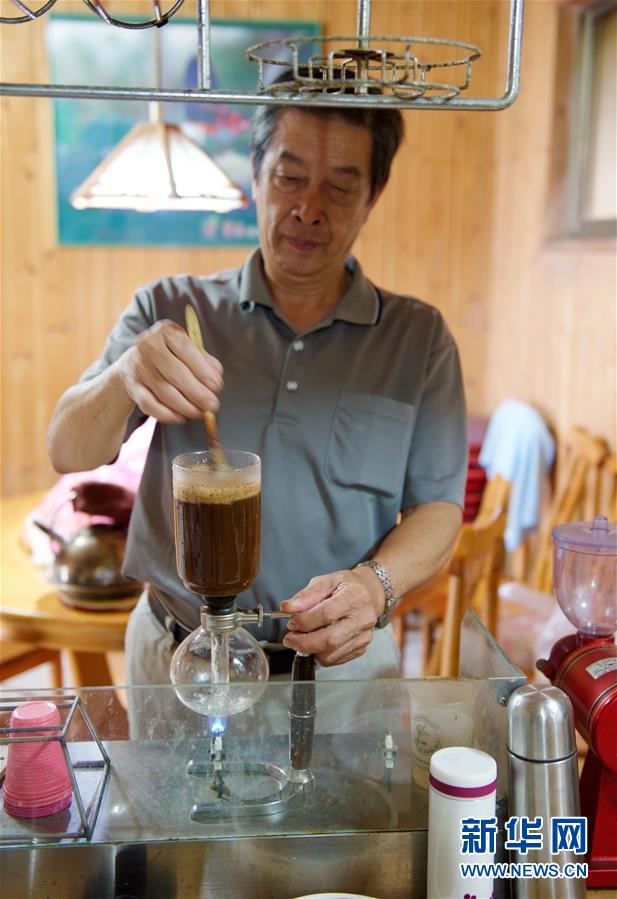
Huashan's "on Coffee"-- the price is not pursued by Baodao, a reporter of Xinhua News Agency stationed in Taiwan.
Liu Qingsong is checking the ripening of coffee beans (photo taken on November 20). Gukeng Township on the Tropic of Cancer, formerly known as an Gukeng, means a warm ancient nest. The altitude, rainfall and sunshine here are all suitable for the growth of coffee trees. As early as the Japanese occupation period, the Japanese initiated the cultivation of coffee. The coffee beans were roasted and extracted, and the coffee beans were sweet, fragrant and not bitter, with a unique flavor. As a result, Gukeng has become the temperature of coffee in Taiwan.